
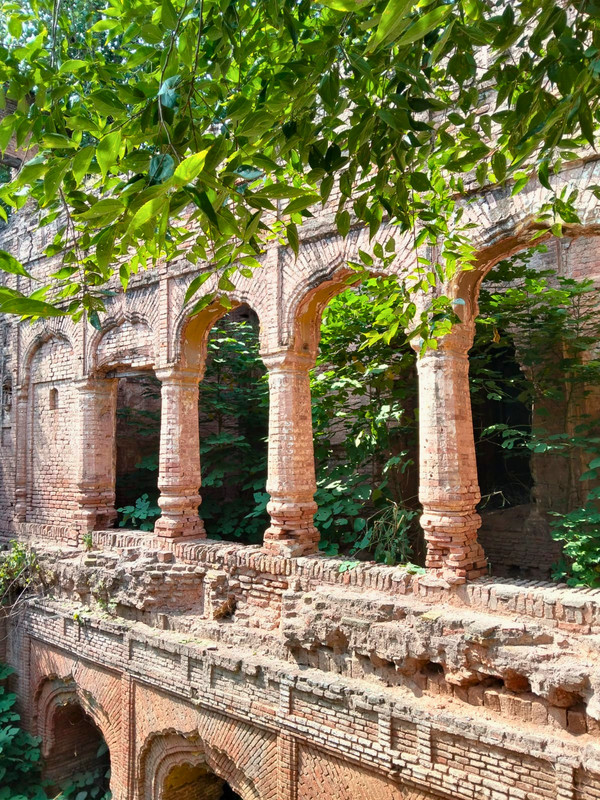
In the winding lanes of Bhabra Bazaar, deep in Rawalpindi's old city, stands a building whose legend has outgrown even its impressive physical presence. Haveli Sujan Singh isn't just another crumbling colonial-era mansion it's a four-storey monument to the wealth, ambition, and taste of one of Rawalpindi's most successful timber merchants. With stories of golden thrones, dancing peacocks, and a pet tiger, this haveli reads more like the setting of a historical epic than an actual address in modern Pakistan.
The Man Behind the Mansion
Haveli Sujan Singh was built in 1893 by Rai Bahadur Sujan Singh, a timber merchant whose business success translated into one of the most opulent private residences in the region. The title "Rai Bahadur," a honorific bestowed by the British colonial administration, signals just how prominent and well-connected Sujan Singh was in his time. Timber was a lucrative trade in colonial Punjab, feeding railway expansion, construction booms, and infrastructure projects across the region and Sujan Singh appears to have capitalized on that demand to build extraordinary personal wealth.
Luxury on a Legendary Scale
What separates Haveli Sujan Singh from other grand residences of its era is the sheer scale of luxury it reportedly contained. Local accounts describe a golden throne inside the haveli, alongside ivory furniture both signifiers of extreme wealth even by the standards of the era's merchant elite. Dancing peacocks reportedly roamed the property, adding a living, moving layer of grandeur to the estate's already extravagant aesthetic.
Perhaps the most eyebrow-raising detail is the claim that Sujan Singh kept a pet tiger on the premises. Whether fully accurate or embellished over generations of storytelling, the detail has become a permanent fixture of the haveli's local legend, reflecting just how larger-than-life the merchant's reputation became. The property also reportedly employed resident musicians, meaning the haveli likely functioned as a hub of entertainment and hospitality, not just a private residence. To top it off, the estate featured a 30-outlet water aqueduct system an impressively advanced piece of engineering for a private home in the late nineteenth century, and a clear sign that no expense was spared in the property's design.
A Building Engineered to Impress
Beyond the legendary furnishings, Haveli Sujan Singh is architecturally significant in its own right. The building spans four storeys and covers more than 24,000 square feet a genuinely massive footprint for a single-family residence, even one built for a wealthy merchant. One of the most distinctive architectural features is found on the top floor, where two separate sections of the building are connected by a bridge, creating a striking visual element and a practical solution for navigating such a sprawling structure.
Interestingly, not all of the haveli's height came from its original construction. The British colonial government later added two additional storeys, reportedly for use as lookout posts. This detail hints at the strategic or administrative value the British placed on the building's height and location within the old city, beyond its role as a private residence.
"Architecturally, the haveli is a genuine fusion piece blending Sikh, Mughal, and British design influences into a single cohesive structure."
Architecturally, the haveli is a genuine fusion piece blending Sikh, Mughal, and British design influences into a single cohesive structure. Kashmiri and Central Asian woodwork appears throughout the interiors, showcasing the kind of specialized craftsmanship that wealthy patrons across the region sought out. An ornate curved staircase serves as a centerpiece feature, while locally cast iron imported from Britain reflects the increasingly globalized construction materials available to elite builders during the height of the colonial period.
Decline After Partition
Like so many grand havelis across Punjab, Sujan Singh's mansion suffered a dramatic reversal of fortune after the Partition of 1947. The Sujan Singh family relocated to Delhi, leaving behind the opulent residence they had built and maintained for over half a century. Without its original owners, the haveli fell into disrepair.
In the years that followed, the building took on a very different role: it became housing for Kashmiri migrants, a far cry from its origins as a showcase of merchant wealth. This transition from private palace to informal migrant housing mirrors the broader story of Partition-era Punjab, where grand properties abandoned by departing families were repurposed, often without the resources needed to preserve their original architectural integrity.
A New Chapter of Restoration
Fortunately, Haveli Sujan Singh's story doesn't end in neglect. In 2006, custodianship of the building was transferred to Fatima Jinnah Women University (FJWU), signaling the beginning of a renewed interest in preserving the structure. This handover placed the haveli under the stewardship of an institution with both the motivation and, eventually, the resources to consider its long-term future.
The real turning point came in 2014, when conservation efforts began in partnership with the National College of Arts one of Pakistan's most respected institutions for art, architecture, and design education. This partnership brought professional conservation expertise to a building that had spent decades deteriorating, with the eventual goal of converting the haveli into a museum.
Why Haveli Sujan Singh Matters Today
For anyone interested in the architectural and social history of colonial Punjab, Haveli Sujan Singh offers a rare, tangible window into the lifestyle of the region's merchant elite. Few surviving buildings so vividly combine legendary personal stories golden thrones, pet tigers, resident musicians with genuinely impressive architectural engineering, like a 30-outlet aqueduct system and a bridge connecting two sections of the top floor.
The building's journey also tells a broader story about Partition, migration, neglect, and eventual restoration a pattern repeated across countless heritage sites in South Asia. As conservation work continues in partnership with the National College of Arts, Haveli Sujan Singh stands as a hopeful example of how historic structures can be rescued from decades of decline and given new purpose as public heritage spaces.
Visiting Bhabra Bazaar
Located in the heart of Rawalpindi's old city, Bhabra Bazaar remains a bustling commercial area, and Haveli Sujan Singh sits somewhat unexpectedly amid the everyday hum of shops and foot traffic. For visitors interested in Rawalpindi's layered history, exploring the bazaar and locating the haveli offers a compelling contrast between the city's present-day commercial energy and its opulent nineteenth-century past. As conservation efforts progress, Haveli Sujan Singh may soon become one of the city's must-see heritage destinations a mansion whose legend has finally started catching up with its long-overdue restoration.